Week 7: (18 March 2019 - 22 March 2019)

Activity:
  1. Designing the external design for the hardware (casing).
  2. Making an illustration for the project hardware based on the proposed design.
  3. Listing all the equipment needed for constructing the external hardware which is the body/casing for the project.
Objective:
  1. To make a suitable design for the system project based on its operation.
  2. Verifying the hardware measurement as the project design was only a prototype for the system project.
  3. Confirming the suitable DC Motor to used on the system.
Content/Procedure:
  1. An illustration of the external hardware was designed with a relevance measurement for a trolley system.
  2. The design was based on a scale of 1:5, which the system project must be 5 times bigger than this prototype project.
  3. Four DC Motor with a range between 3V - 6V, four wheels, and L298N Motor Driver module were purchased.
Measurement Details 

Selected DC Motor with its Wheel
Result & Analysis:
  1. The wheel and the DC Motor will act as a leg for the system project where the operation of moving either Forward, Backward, Turning Left and Turning Right was based on the coding algorithms.
  2. The rotation of the DC Motor depends on the current direction which will be controlled by L298N Motor Driver.
  3. The equipment for constructing the external hardware was listed and purchased such as perspex, screw and nat, and PVC Pipe.
List of Equipment and Components to Prepare

Listed of Components Purchased

L298N Motor Driver Module
Conclusion:
Truth Table for the System Operation
The project external design must be completed in order to proceed for coding testing and project performance.
DC Motor Performance Testing


Week 6: (11 March 2019 - 15 March 2019)

Activity:
  1. FYP2 Workshop: (Workshop on Chapter 4, Chapter 5 and Abstract Writing)
Objective:
  1. To notify the details regarding Chapter 4, Chapter 5 and Abstract Writing for Final Report 
Content/Procedure:
  1. FYP2 second briefing was held on 13 March 2019 (3.00pm - 5.00pm).
  2. Conduct by FYP Coordinator, Dr. Marwangi at TTL1.
  3. Chapter 4 was split into two parts which are Results & Discussion.
  4. In this chapter, it was started with Introduction as 4.1 and Results & Discussion as 4.2 which are advisable.
  5. As for 4.1, will contain the introduction of the chapter and as for 4.2, it contains the graphs & tables (measurement). The graph part is suggested since it is easier to analyze the discussion and the table part is the measurement of the result itself. These will make the results were easier to analyze. 
  6. The case studies, it depends on the objectives which content the table, graph and analyze. Start at this part (Chapter 4 & 5), the tenses must be in the present tense.
Result & Analysis:
  1. As chapter 4 (Results & Discussion),  may describe the conditions under which the results were obtained. Pictures must be accompanied with description - NOT JUST IMAGE ALONE.
  2. Illustrate the results in an appropriate way - diagrams, graphs, and charts. (Figures must be clearly shown and label, graphs must have title, axes, legend, and charts must be easy to understand).
  3. Discuss/analyze results - not limited to explaining steps/procedures, don't repeat tabulated values, statistical calculation -  mean, average, standard deviation, error %, repeated the measurement for consistency and comparison with other work/other technique.
  4. As chapter 5 (Conclusion), which the findings are concisely summarized, must be reflected back to the objectives of the project/research. Explain either the objectives are achieved or not. If the objectives not achieve, then explain why and state the recommendation for future work. If the objectives achieved, a state which objectives and what has been achieved. 
  5. As for the further recommendation, it must be related to the project/research, it must be reasonable/logical/achievable and it can be implemented in the future.
Conclusion:
The details and outline works of Chapter 4 & 5 were notified and discovered by the workshop on Results & Discussion (Chapter 4) and Conclusion (Chapter 5) in Thesis Writing that has been held. The figure below shows the slideshow presentation of the briefing.


1
2

3
4


6

5


8
7


9
10


Week 5: (4 March 2019 - 8 March 2019)

Activity:
  1. Constructing, assembling and soldering the Ultrasonic Transmitter and Receiver circuit.
  2. Testing the performance for the Ultrasonic design.
Objective:
  1. For testing the performance of the Ultrasonic Transmitter and Receiver
  2. To generate and detect ultrasounds by using 40kHz transducer. 
Content/Procedure
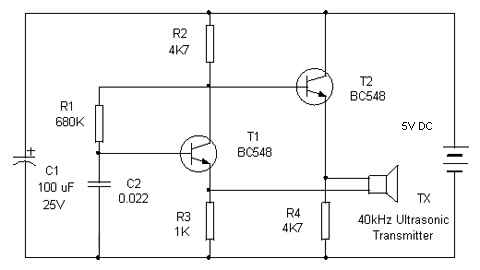
  1. The circuit for both Transmitter and the Receiver had been assembled and soldered based on circuit design on software tool Eagle CAD. 
  2. The performance of both sensors was tested using an oscilloscope.
  3. An oscillator was set for 35-45 kHz frequency on the Ultrasonic Transmitter by using a 556 dual-timer, a microcontroller, and the discrete components.
Constructing the Ultrasonic Circuit on a Breadboard
Transmitter Circuit Diagram

Ultrasonic Transmitter and Receiver Signal Perfomance Testing

Result & Analysis:
  1. The Receiver was returning the detected signal from the Transmitter more than 100mV at approximately 4 meters between them.
  2. When the range at less than 1 meter, the Receiver putting out approximately about 4V.
  3. This shows that the Transmitter emission cone's angle is almost 40 degrees wide.
Digital Oscilloscope for Personal Used

Signal Shape at Transmitter
Signal Shape at Receiver
Conclusion:
  1. These Ultrasonic Sensor modules can be hooked up to a microcontroller’s ADC port, which will return distance dependent voltages. 
  2. These modules are capable of locating the direction of an Ultrasounds signal and also estimating the distance from them based on certain algorithms.
  3. The output is via the “signal” pin, which will provide approximately 0.5V depending on the power level of the detected ultrasonic signal.
Ultrasonic Transmitter

Ultrasonic Receiver
Testing the Performance of the Sensor

Week 4: (25 February 2019 - 28 February 2019)

Activity:
  1. Proceed on buying and constructing Ultrasonic Transmitter and Receiver sensor.
  2. Petition to change FYP2 Presentation
Objective:
  1. Constructing the sensor circuit and testing the performance of the sensor.
  2. To changing or more precisely delaying the FYP2 Presentation.
Content/Procedure:
  1. Continued on constructing the circuit and testing the performance of the Ultrasonic sensor new module.
  2. A PCB (Printed Circuit Board) for the Ultrasonic Transmitter and Receiver had been made by using the etching process step.
  3. On 26 February 2019, a petition had been made by SRC (Student Representative Council) and Senior Students Leader, Zarifi Razak, for changing/delaying the FYP2 Presentation from Week 11 to another week. 
Saw Blade for Cutting Copper-Clad Plate Board

Result & Analysis:
  1. Both of the Transmitter and Receiver sensor was constructed and the performance of the circuit will be tested next week.
  2. On 28 February 2019, the result of the petition for changing/delaying the FYP2 Presentation had been made by chancellory.
Receipt for Etching and Soldering Process
Cutting Copper Plate
Etching Process
Circuit Board
Conclusion:
The petition for delaying the FYP2 Presentation was declined as the management had their own reasons.
Result for the Petition
Reason for Declining the Petition