Activity:
- Constructing, assembling and soldering the Ultrasonic Transmitter and Receiver circuit.
- Testing the performance for the Ultrasonic design.
Objective:
- For testing the performance of the Ultrasonic Transmitter and Receiver
- To generate and detect ultrasounds by using 40kHz transducer.
Content/Procedure
- The circuit for both Transmitter and the Receiver had been assembled and soldered based on circuit design on software tool Eagle CAD.
- The performance of both sensors was tested using an oscilloscope.
- An oscillator was set for 35-45 kHz frequency on the Ultrasonic Transmitter by using a 556 dual-timer, a microcontroller, and the discrete components.
 |
| Constructing the Ultrasonic Circuit on a Breadboard |
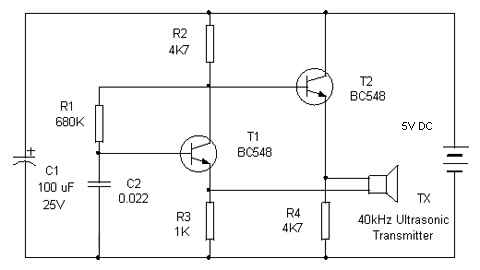 |
| Transmitter Circuit Diagram |
Ultrasonic Transmitter and Receiver Signal Perfomance Testing
Result & Analysis:
- The Receiver was returning the detected signal from the Transmitter more than 100mV at approximately 4 meters between them.
- When the range at less than 1 meter, the Receiver putting out approximately about 4V.
- This shows that the Transmitter emission cone's angle is almost 40 degrees wide.
 |
| Digital Oscilloscope for Personal Used |
 |
| Signal Shape at Transmitter |
 |
| Signal Shape at Receiver |
Conclusion:
- These Ultrasonic Sensor modules can be hooked up to a microcontroller’s ADC port, which will return distance dependent voltages.
- These modules are capable of locating the direction of an Ultrasounds signal and also estimating the distance from them based on certain algorithms.
- The output is via the “signal” pin, which will provide approximately 0.5V depending on the power level of the detected ultrasonic signal.
 |
| Ultrasonic Transmitter |
 |
| Ultrasonic Receiver |
 |
| Testing the Performance of the Sensor |

No comments:
Post a Comment